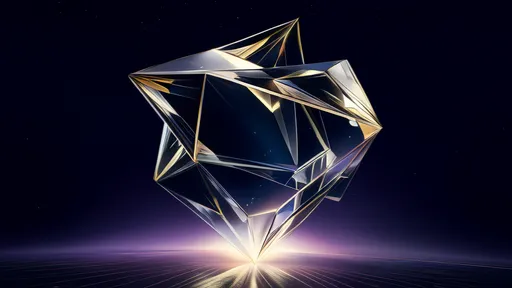
The world of geometry is experiencing a quiet yet profound renaissance, one that harkens back to the classical elegance of polyhedral forms while embracing contemporary computational possibilities. Across design studios, architectural firms, and mathematical research departments, there's a growing fascination with the art and science of polyhedral dissection – the practice of strategically cutting three-dimensional shapes into smaller, often interlocking components.
This resurgence isn't merely academic nostalgia. Modern fabrication technologies like CNC milling and 3D printing have transformed what was once theoretical into the physically tangible. Designers are rediscovering how polyhedra – from the Platonic solids to more complex Archimedean and Catalan forms – offer unparalleled structural integrity and aesthetic versatility when properly segmented. The ancient practice of stellation (extending face planes until they intersect) and faceting (creating new faces within existing polyhedra) has found new life in parametric design software.
Architecture leads this geometric revival, with firms experimenting with polyhedral modules for everything from decorative screens to load-bearing walls. The Beijing Daxing International Airport's spectacular ceiling, composed of massive aluminum polyhedral units, demonstrates how these geometric principles scale to monumental proportions. Meanwhile, furniture designers are creating transformable pieces using hinged polyhedral components that fold according to precise angular relationships.
The mathematical community has contributed crucial insights about the minimum number of cuts required to decompose polyhedra into reassemblable pieces. Recent proofs have established fundamental rules about partitionability that inform both pure mathematics and practical applications. These discoveries ripple outward, influencing how product designers conceive modular assemblies and how artists approach geometric sculpture.
Material science advancements have been equally transformative. New composites and smart materials allow polyhedral components to change properties – some can alter rigidity on command, while others incorporate sensors that monitor structural stress. This marriage of ancient geometry with cutting-edge technology creates possibilities unimaginable to Renaissance geometers like Piero della Francesca or Luca Pacioli, who first systematized polyhedral studies.
Educational approaches are evolving alongside these developments. Progressive pedagogy emphasizes hands-on polyhedral construction to develop spatial reasoning, with students using laser-cut kits to explore truncations, duals, and other transformations. This tactile engagement contrasts sharply with the abstract vector geometry that dominated 20th-century curricula, representing a return to more physically intuitive mathematical learning.
The cultural dimensions of this revival warrant attention. In an era of digital intangibility, there's growing appreciation for the haptic quality of precisely crafted geometric forms. Art installations featuring suspended polyhedral clusters draw crowds seeking contemplative encounters with mathematical beauty. This phenomenon parallels the renewed popularity of analog technologies like vinyl records – both represent a desire for tangible, sensorily rich experiences in an increasingly virtual world.
Looking ahead, researchers speculate about four-dimensional polyhedral analogs and their potential applications in representing complex data structures. While such concepts remain largely theoretical, they demonstrate how classical geometry continues inspiring innovation. The current polyhedral renaissance isn't about replicating past achievements, but rather reinterpreting timeless mathematical truths through contemporary lenses – proving that some intellectual frameworks possess enduring relevance across centuries.
From microscopic metamaterials to monumental architecture, the strategic dissection and recombination of polyhedral forms is establishing itself as a unifying design language for our era. This geometric revival transcends disciplinary boundaries, offering a common vocabulary to mathematicians, artists, and engineers alike. As fabrication technologies advance and material possibilities expand, the applications of polyhedral cutting will likely proliferate further, cementing this ancient geometric practice as a distinctly modern creative methodology.
By /Aug 11, 2025
By /Aug 11, 2025
By /Aug 11, 2025

By /Aug 11, 2025

By /Aug 11, 2025
By /Aug 11, 2025
By /Aug 11, 2025

By /Aug 11, 2025
By /Aug 11, 2025

By /Aug 11, 2025

By /Aug 11, 2025

By /Aug 11, 2025
By /Aug 11, 2025

By /Aug 11, 2025
By /Aug 11, 2025
By /Aug 11, 2025
By /Aug 11, 2025
By /Aug 11, 2025
By /Aug 11, 2025

By /Aug 11, 2025