The world of colored diamonds operates on an entirely different valuation paradigm compared to their colorless counterparts. While the traditional D-to-Z scale governs white diamonds, Fancy Color Diamonds derive their worth from an intricate interplay of hue, saturation, and tone. The term "Fancy" isn't merely descriptive—it's a technical classification that triggers exponential price multipliers in the gemstone market. Understanding how grading laboratories delineate these color thresholds reveals why some pink diamonds command six figures per carat while others languish in commercial jewelry stores.
At the heart of the matter lies the GIA's Fancy Color Grading System, which transformed the industry when introduced in the 1970s. Unlike the subtractive color model used for white diamonds (where less color means higher value), this system celebrates chromatic intensity. The baseline begins with Faint, Very Light, and Light designations—stones that wouldn't qualify as "Fancy" at all. The magic starts at Fancy Light, progressing through Fancy, Fancy Intense, Fancy Vivid, and Fancy Deep/Dark. Each upward shift in saturation can increase per-carat prices by 30-50%, creating stair-step premiums that defy conventional diamond pricing logic.
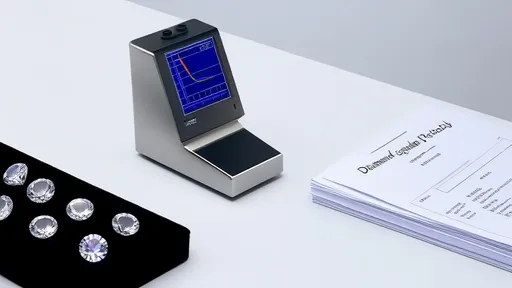
Laboratory color grading resembles a high-stakes chromatic ballet. Master graders examine stones under precisely calibrated daylight-equivalent lamps, comparing them to control sets worth millions. The difference between a Fancy Intense Yellow and a Fancy Vivid Yellow might hinge on how a diamond's hue modifier—say, a greenish secondary tone—interacts with the dominant color. Some argue the system contains intentional gray areas; a stone grading Fancy Intense at one lab might receive Fancy Vivid at another, creating arbitrage opportunities that seasoned dealers exploit.
Market dynamics further complicate the picture. The supply-demand imbalance for certain colors creates artificial cliffs in pricing. A Fancy Intense Pink diamond might trade at $300,000 per carat, while a similar-clarity Fancy Vivid Pink could hit $1.5 million—not because the color difference is objectively fivefold better, but because collectors treat the Vivid grade as a trophy asset. Auction houses strategically emphasize these grading boundaries in their catalogs, knowing that two nearly-identical blue diamonds separated by one color grade might fetch wildly different hammer prices.
Cutting techniques introduce another layer of complexity. Unlike white diamonds cut for maximum brilliance, Fancy Color Diamonds often receive unconventional cuts to amplify their chromatic properties. A poorly cut Fancy Deep Blue might appear nearly black from some angles, while a master cutter's work could make the same rough yield a stone that dances with electric cobalt hues. This explains why some dealers pay premiums for "pre-graded" rough—they're betting their cutters can nudge the final product into a higher color category.
The investment landscape has begun recognizing these nuances. Hedge funds now treat high-grade Fancy Color diamonds as non-correlated assets, with some establishing color-specific funds (a pink diamond fund, a blue diamond fund, etc.). Their due diligence teams include former lab graders who can predict how borderline stones might regrade over time—because in this market, a certificate update from Fancy to Fancy Intense can mean a seven-figure windfall. As synthetic colored diamonds improve, these natural grading distinctions become even more critical as authenticity markers.
Consumer markets show fascinating segmentation. Chinese buyers traditionally preferred pure red or pink hues, while Middle Eastern collectors favor vivid yellow and orange diamonds with Islamic cultural significance. Western millennials drive demand for unconventional colors like violet and gray, often prioritizing uniqueness over traditional quality metrics. This cultural prism means a Fancy Brown diamond might sell at Costco for $2,000 per carat yet command $20,000 per carat in Dubai as a "champagne" diamond—proof that color semantics can outweigh gemological reality.
Looking ahead, the Fancy color grading system faces challenges from AI-assisted grading and blockchain certification. Some labs already use spectrophotometric mapping to create color "fingerprints," potentially making human graders obsolete. Yet the market might resist—part of a Fancy diamond's romance lies in the human expertise behind its classification. As mines like Argyle close (responsible for 90% of pink diamonds), these color grades will become not just quality indicators but historical artifacts, cementing their premiums for generations to come.
By /Aug 11, 2025
By /Aug 11, 2025
By /Aug 11, 2025

By /Aug 11, 2025

By /Aug 11, 2025
By /Aug 11, 2025
By /Aug 11, 2025

By /Aug 11, 2025
By /Aug 11, 2025

By /Aug 11, 2025

By /Aug 11, 2025

By /Aug 11, 2025
By /Aug 11, 2025
By /Aug 11, 2025

By /Aug 11, 2025

By /Aug 11, 2025
By /Aug 11, 2025
By /Aug 11, 2025
By /Aug 11, 2025

By /Aug 11, 2025