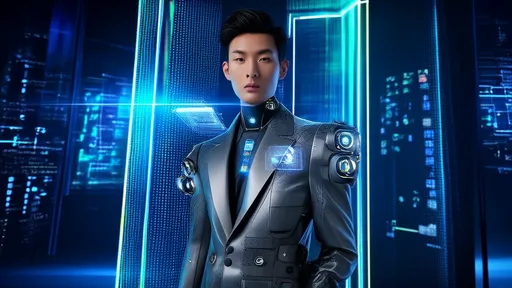
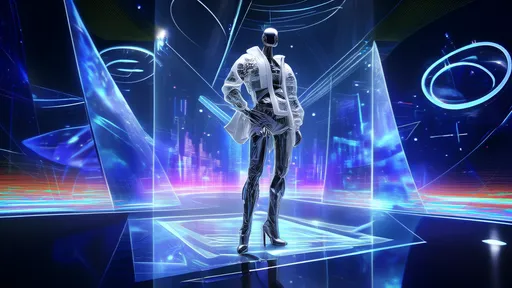
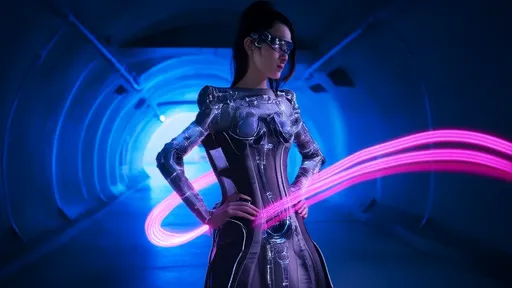
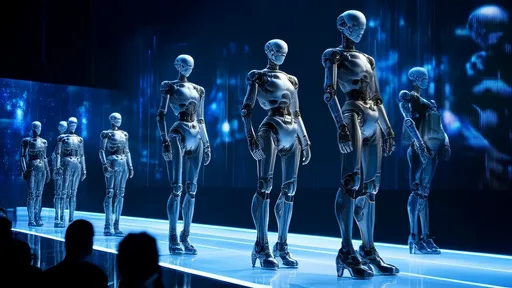
The fashion world is witnessing a revolutionary fusion of technology and textile artistry as designers draw inspiration from the mesmerizing "Ice Ribbon" aesthetic. This avant-garde movement combines mechanical engineering with luminous elements to create garments that don't merely adorn the body but perform intricate dances of light and motion.
At the heart of this innovation lies the delicate balance between structural integrity and fluid movement. Designers are incorporating miniature servo motors, shape-memory alloys, and flexible circuit boards into fabric substrates that mimic the graceful undulations of ice skaters' ribbons. These hidden mechanisms work in harmony to produce subtle yet captivating movements that respond to both the wearer's motion and environmental stimuli.
The lighting elements transform these creations into living canvases. Fiber optics woven directly into the fabric create ethereal glow patterns that shift like auroras across the garment's surface. Programmable LED clusters embedded at strategic points interact with the mechanical movements to produce synchronized light shows. Some designs even incorporate electroluminescent wires that trace the garment's contours with pulsing neon-like energy.
What makes these technological couture pieces truly remarkable is their ability to maintain wearability despite their complex inner workings. Designers have developed innovative solutions for power supply challenges, creating flexible battery packs that conform to the body's shape and kinetic energy harvesting systems that convert movement into electricity. The result is fashion that feels as light as traditional garments while offering unprecedented interactive possibilities.
The Ice Ribbon influence manifests most strikingly in the fluid transitions between states of rigidity and flow. Specialized materials allow certain sections of the garments to stiffen or relax on command, creating the illusion of frozen fabric suddenly coming to life. This metamorphic quality captures the essence of winter sports - the moment when a skater's rigid preparation melts into graceful motion.
Contemporary designers are pushing boundaries by integrating responsive technologies that make these garments interactive artworks. Some respond to ambient temperature changes with corresponding shifts in lighting color temperature, visually expressing thermal dynamics. Others incorporate motion sensors that trigger specific mechanical sequences when the wearer performs particular gestures, effectively creating a sartorial language of movement.
The production process for these hybrid garments requires unprecedented collaboration between fashion houses and engineering firms. Traditional pattern-making techniques merge with 3D modeling software typically used for robotic design. Seamstresses work alongside electrical engineers to ensure every circuit and stitch coexist perfectly. This interdisciplinary approach is birthing a new generation of designer-engineers fluent in both couture aesthetics and mechatronics.
Audience reactions to these kinetic creations reveal their emotional power. During runway presentations, spectators frequently describe experiencing synesthetic sensations - feeling as though they can hear the whisper of moving fabric or taste the crispness of the cool-toned lighting. The garments create immersive environments that transcend traditional fashion shows, becoming performance art installations where technology and humanity intersect.
As this movement evolves, designers are exploring more sustainable approaches to technological fashion. Some are experimenting with biodegradable circuitry and recyclable actuators to reduce electronic waste. Others are developing modular systems where mechanical components can be removed and reused in new garments. These ecological considerations ensure that the fusion of fashion and technology develops responsibly.
The Ice Ribbon-inspired movement represents more than just technical innovation - it signals a fundamental shift in how we conceptualize clothing. These garments don't simply change with fashion seasons; they change within single wearings, sometimes within minutes. They challenge static notions of beauty by celebrating transformation itself as the ultimate aesthetic statement. In doing so, they reflect our increasingly dynamic world where change is the only constant.
Looking ahead, this convergence of mechanical engineering and illuminated fashion promises to reshape not just haute couture but everyday wear. Prototypes already exist for more accessible versions featuring simplified mechanisms and lighting effects. As the technology becomes more refined and affordable, we may soon see elements of this kinetic aesthetic filtering down to mass-market fashion, forever altering our relationship with what we wear.

By /Aug 15, 2025
By /Aug 15, 2025

By /Aug 15, 2025
By /Aug 15, 2025
By /Aug 15, 2025
By /Aug 15, 2025
By /Aug 15, 2025

By /Aug 15, 2025
By /Aug 15, 2025
By /Aug 15, 2025
By /Aug 15, 2025

By /Aug 15, 2025
By /Aug 15, 2025

By /Aug 15, 2025

By /Aug 15, 2025

By /Aug 15, 2025
By /Aug 15, 2025
By /Aug 15, 2025
By /Aug 15, 2025
By /Aug 15, 2025