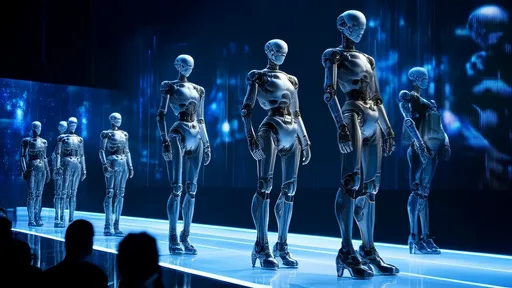
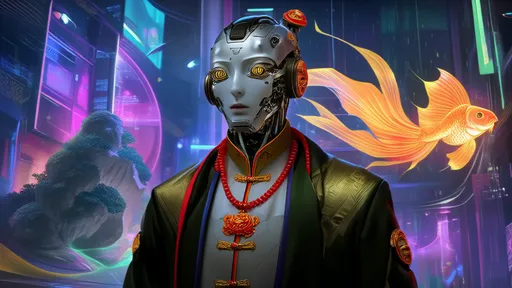
The runway lights dim as an otherworldly figure glides forward with impossible grace. Its movements carry the weightless precision only achievable through advanced robotics, yet the flowing silk garments whisper of dynasties past. This isn't science fiction - it's the cutting edge of where millennia-old Chinese aesthetics collide with tomorrow's technology on fashion's most avant-garde stage: the humanoid robot catwalk.
Across Shanghai's Huangpu River, where neon reflections dance on water that once carried imperial trade ships, a new generation of designers are rewriting the rules of cultural expression. The recent "Silicon & Silk" showcase stunned audiences by presenting twelve humanoid models wearing digitally reconstructed interpretations of Tang Dynasty court attire, their movements programmed to emulate the "cloud gait" described in ancient poetry. The collection's lead designer, Lin Xiao, spent eighteen months collaborating with robotics engineers to perfect the subtle wrist rotations that make hanfu sleeves flutter with organic unpredictability.
What makes these presentations revolutionary isn't merely the novelty of machine models, but how deeply the technological framework has been imbued with philosophical traditions. The robots' facial recognition systems don't just track audiences - they're trained to identify and respond to specific scholars' rocks in the front row, mirroring the Song Dynasty practice of "listening to stones." When Model XR-9 paused mid-stride to tilt its head toward a porous Taihu rock, the gesture wasn't random code; it was artificial intelligence interpreting Confucian concepts of finding wisdom in nature.
Beneath the spectacle lies serious innovation in material science. The "moonlight robe" that shimmered during the finale isn't embedded with LEDs as assumed, but woven from piezoelectric fibers that generate their own luminescence when moved - a modern incarnation of the bioluminescent silks mentioned in Ming Dynasty texts. Professor Wu of Tsinghua University's Wearable Computing Lab confirms this marks the first successful large-scale application of energy-harvesting smart textiles that don't require external power sources. "We've essentially created fabric that breathes like ancient ramie, but produces light like fireflies," she explains.
The movement algorithms powering these robotic models reveal another layer of cultural synthesis. Rather than adopting the hyper-precise motions typical of industrial robots, engineers studied Peking Opera movements and calligraphy brush techniques to develop what they term "algorithmic spontaneity." The result is models that turn with the deliberate grace of ink dispersing in water, their gestures carrying the xieyi (写意) style's emphasis on expressive essence over literal representation. This technical achievement required teaching machines to intentionally "miss" certain positioning targets - a counterintuitive approach that left German robotics teams baffled during knowledge-sharing sessions.
Perhaps most striking is how these shows subvert expectations of futurism. While Western tech fashion often leans toward metallic minimalism, the Chinese cyborg aesthetic celebrates ornate complexity. One showstopper piece featured a "dragon scale" bodice constructed from 2,138 interlocking ceramic platelets 3D-printed with nanoscale porosity to mimic actual keratin structures, each piece hand-glazed using celadon techniques dating back to the Southern Song kilns. The effect? A garment weighing less than 800 grams that moves like liquid jade when the robot walks, its surface refracting light differently with every step due to subsurface scattering algorithms.
Audience reactions underscore the emotional resonance achieved through this fusion. When humanoid M-7B2 performed a 23-second sequence replicating the "sleeve fluttering" dance from the Dunhuang murals, complete with machine-learned variations in fabric drape physics, multiple attendees reported tearing up - an unusual response to what's essentially precision actuators executing code. Psychologists attribute this to the "uncanny valley" working in reverse: when artificial entities exhibit culturally familiar grace rather than attempting human realism, they trigger deep aesthetic recognition without the discomfort of near-human mimicry.
Behind the scenes, these productions are driving unexpected collaborations. The embroidery on several pieces was "painted" by robotic arms guided by AI that studied stitches from Imperial workshops, but the gold threads were hand-twisted by artisans from Suzhou's last traditional silk mill. This marriage of heritage craftsmanship and algorithmic precision has birthed hybrid techniques - like using convolutional neural networks to optimize the placement of seed pearls originally arranged according to Bagua symmetry principles.
As dawn breaks over Beijing's Central Academy of Fine Arts, where the next generation of cyber-fashion pioneers train, students toggle between studying Song Dynasty landscape composition and programming fluid dynamics simulations. Their projects hint at what's coming: qi-inspired "energy flow" dresses that change color based on the wearer's movements, headdresses incorporating flexible perovskite solar cells shaped like phoenix feathers, and even explorations of how to make robots appear to "breathe" using pneumatics synchronized to guqin musical rhythms. The future of fashion won't just be worn - it will move with the weight of history and the lightness of innovation.
The implications extend beyond the runway. When Huawei's engineers adapted the fabric sensor networks from these fashion experiments for medical use, they discovered the pressure-sensitive embroidery could monitor Parkinson's tremors with 40% greater accuracy than conventional wearables. Meanwhile, museums are licensing the movement-capture data from robotic Tang Dynasty dances to create more authentic historical VR experiences. This feedback loop between past and future grows stronger with each passing season.
Standing before a newly unveiled humanoid model whose faceplate subtly shifts between twenty-four traditional makeup styles corresponding to solar terms, one grasps the profound statement being made. This isn't technology appropriating culture as surface decoration, but rather the reactivation of aesthetic DNA in a new medium. As the robots take their final walk down runways from Shenzhen to Milan, their every step pulses with a quiet revelation: the future belongs to those who can make circuits sing with the voices of ancestors.

By /Aug 15, 2025
By /Aug 15, 2025

By /Aug 15, 2025
By /Aug 15, 2025
By /Aug 15, 2025
By /Aug 15, 2025
By /Aug 15, 2025
By /Aug 15, 2025
By /Aug 15, 2025
By /Aug 15, 2025
By /Aug 15, 2025
By /Aug 15, 2025
By /Aug 15, 2025

By /Aug 15, 2025
By /Aug 15, 2025
By /Aug 15, 2025
By /Aug 15, 2025
By /Aug 15, 2025

By /Aug 15, 2025
By /Aug 15, 2025